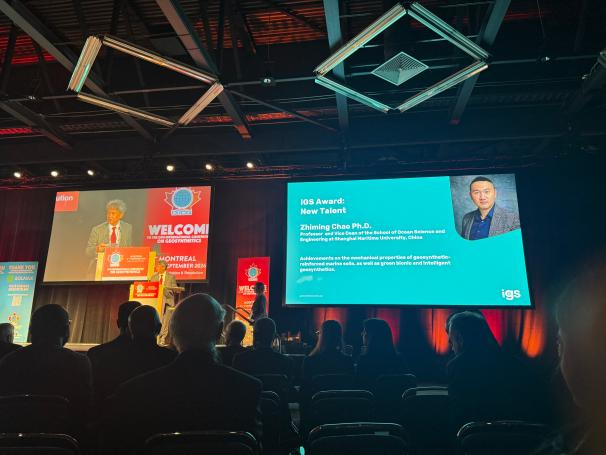
From September 13 to 17, 2026, the 13th International Conference on Geosynthetics (13ICG) was held in Montreal, Canada. With the theme “Heritage, Evolution and Innovation of Geosynthetics”, the conference brought together experts and scholars worldwide in the field of geosynthetics to exchange cutting-edge disciplinary advances and engineering innovations.
During the conference, the International Geosynthetics Society (IGS) presented a series of awards to recognize individuals and teams with outstanding achievements in geosynthetics research, technological innovation and engineering applications over the past four years.
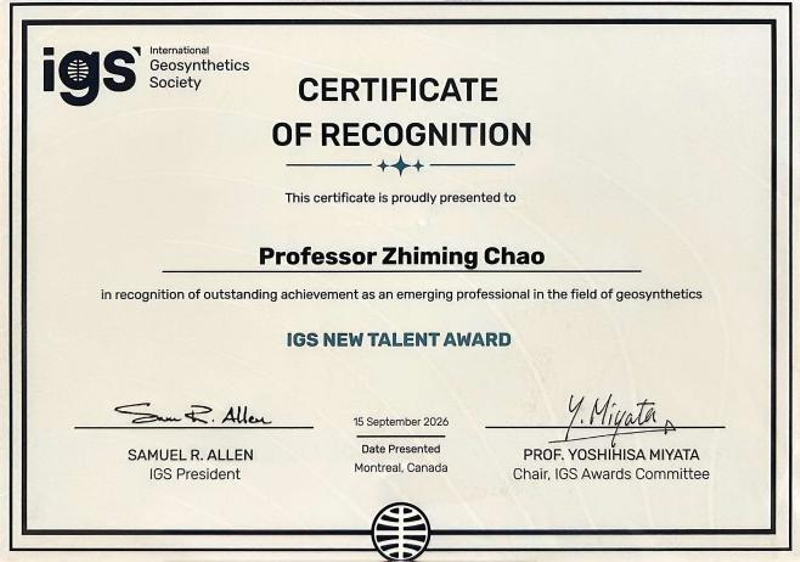
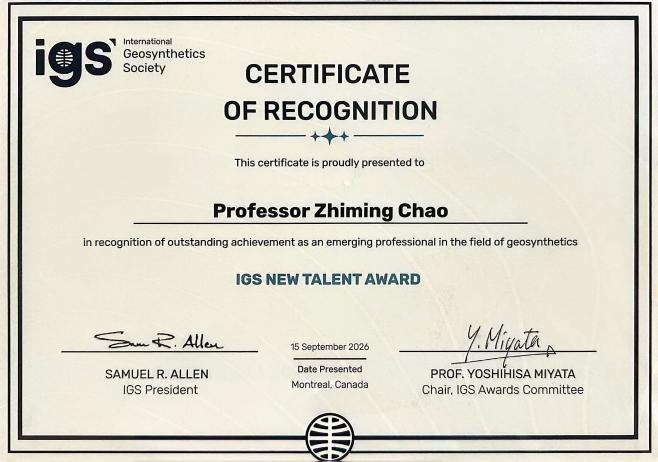
Professor Chao Zhiming from the College of Marine Science and Engineering, Shanghai Maritime University, was awarded the IGS New Talent Award. Presented once every four years, this is the highest technical achievement award of IGS for young scholars under 35 years old. Recipients are selected globally, with a maximum of three awardees each time. The award honors young researchers with remarkable academic accomplishments and contributions to the industry. Professor Chao Zhiming has long devoted himself to research on geosynthetic-reinforced marine soil mechanics, green bionic geosynthetics and intelligent geosynthetics. He is committed to integrating fundamental theoretical research on geosynthetics with practical demands in ocean engineering. In recent years, targeting typical marine soils such as coral sand and soft soil, as well as complex marine environmental factors including temperature, humidity, salinity, wet-dry cycles and thermal cycles, he has systematically investigated the mechanical and bearing performance of geosynthetic-soil interfaces and reinforced soil/foundation systems. His relevant findings have gained wide recognition. His research was featured in a special report by Science and Technology Daily, titled “Chao Zhiming: Consolidating the Foundation of Offshore Facilities”.
The IGS New Talent Award recognizes Professor Chao’s continuous research efforts at the intersection of geosynthetics and marine geotechnical engineering. His research covers interfacial mechanics of geosynthetics under harsh marine environments, geosynthetic-reinforced coral sand, bionic and intelligent geosynthetics, green and low-carbon foundation improvement, and AI-enabled smart monitoring of marine infrastructure. Integrating green low-carbon technologies, artificial intelligence and other advanced approaches, his work keeps expanding the application scope of geosynthetics in ocean engineering and promotes the transformation of laboratory results into engineering practice.
This honor results from his long-term dedication to research. It also reflects the college’s strong support for the growth of young faculty members and scientific research. The college will continue to support young talents to carry out original research in ocean engineering, supporting the university’s development into a high-level university and industrial advancement.
Figure 1 Scene of the Conference