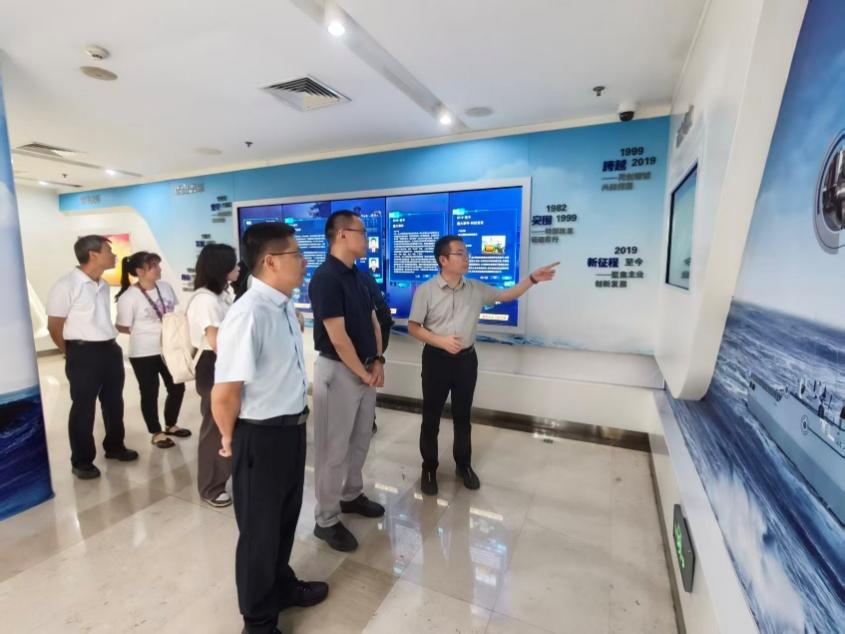
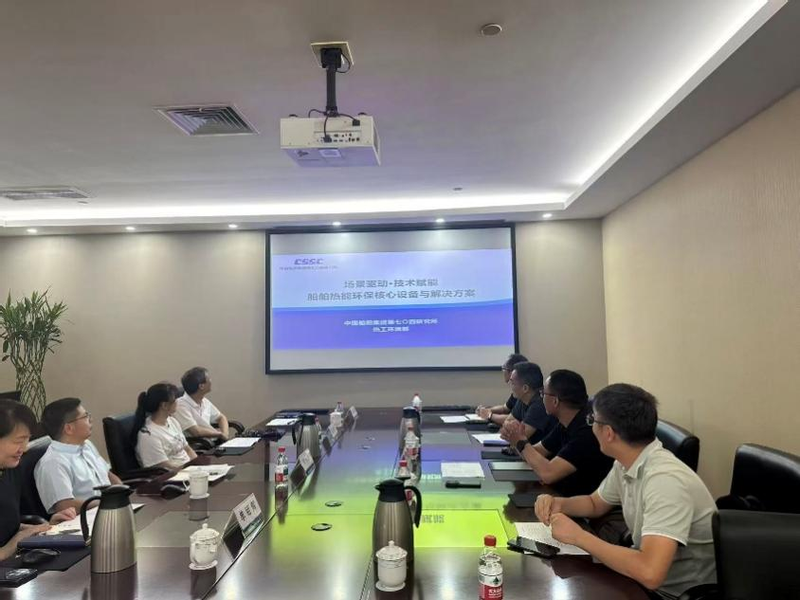
To further deepen industry-university-research collaborative innovation and promote the precise connection between scientific research innovation and industrial demands, Feng Daolun, Dean of the College of Marine Science and Engineering, and Lü Baoyi, Director of the Marine Environment Department, visited No.704 Research Institute of China State Shipbuilding Corporation (CSSC) on July 21, 2026. The Chief Accountant and relevant principals of the institute received the delegation. Both sides conducted in-depth discussions on scientific research progress, key technical problems and future cooperative plans.
At the beginning of the seminar, the institute’s administrative director introduced the overall development and business layout of No.704 Research Institute. As one of the largest and most influential research institutions specializing in special marine equipment and auxiliary electromechanical equipment in China, the institute has more than 60 years of development experience. It focuses on the R&D, design, production and integrated services of marine system equipment, and has formed seven major business sectors, including power and electric systems, aviation support, marine devices, thermal energy and environmental protection, vibration and degaussing control, non-marine equipment, as well as testing and standard research.
On behalf of the college, Feng Daolun expressed gratitude for the warm reception. He introduced the college’s development history, discipline construction, research teams and innovative achievements. He pointed out that the institute has profound technical accumulation and unique industrial advantages in marine equipment research, which is highly consistent with the college’s research orientation. Both sides will establish a regular communication mechanism and carry out in-depth cooperation in scientific research project application, technical research and achievement transformation to realize complementary advantages and win-win development.
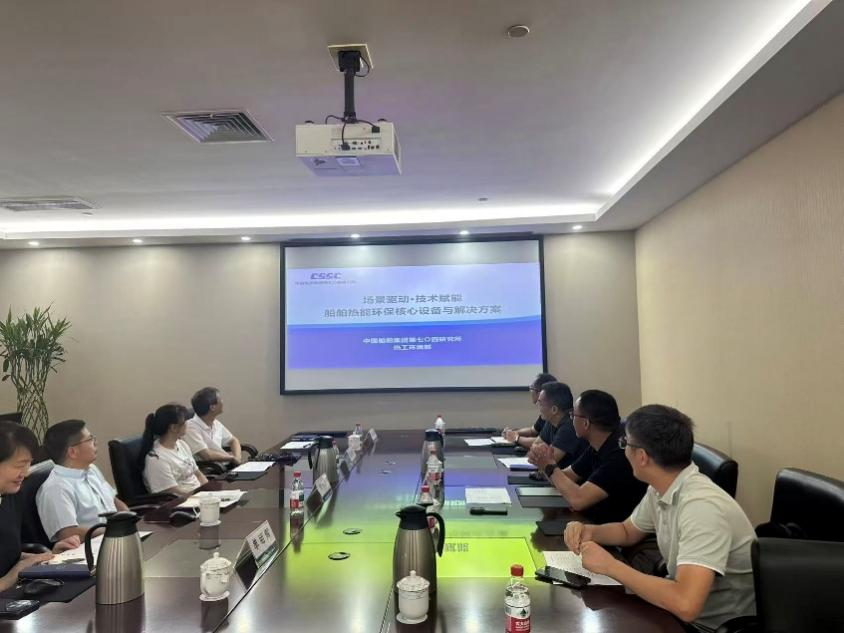
The person in charge of the Thermal and Environmental Engineering Department delivered a special report on core equipment and technical solutions for marine thermal energy and environmental protection, illustrating the development trends and application prospects of related technologies. The two sides had in-depth exchanges on key technical bottlenecks, experimental design and innovative research ideas in marine equipment research.
This visit effectively strengthened the college’s understanding of cutting-edge industrial technologies and development trends, providing important reference for optimizing scientific research layout and expanding cooperative channels. In the next step, the college will continue to deepen school-institute cooperation, promote industry-university-research integration, and contribute to the high-quality development of the marine and shipping industry through technological innovation and talent cultivation.
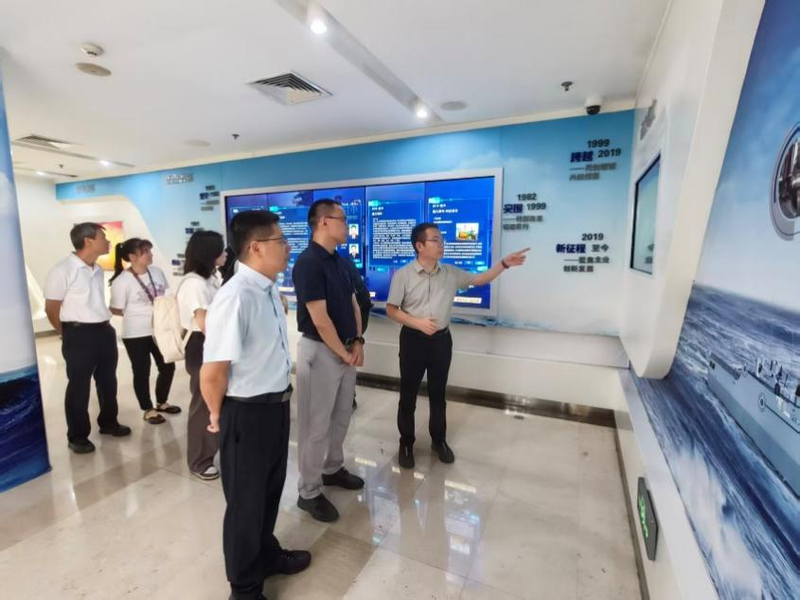
Figure 1 Highlights of the Visi