
To help students majoring in Ship and Ocean Engineering solve their academic problems and clarify their development directions, the College of Marine Science and Engineering held the sixth session of full-time teachers' on-duty Q&A and self-study tutoring activities in the one-stop student community of Building 60 on November 19th. Provide precise guidance for students on core issues such as planning for postgraduate recommendation and entrance examination, competition research, and course study.
During the daytime Q&A session, Teacher Hou Xianrui focused on the students' long-term development plans and provided systematic and practical guidance. Regarding the recommendation for postgraduate studies, he proposed a gradient strategy of "prioritizing the pursuit of academic master's degrees at top universities, with the university serving as a safe safety net", and reminded students to pay attention to the differences in training among various types of degrees. For postgraduate entrance examination preparation, Teacher Hou clearly pointed out that mathematics is the key to improving scores, recommended the method of "combining the sea of exercises strategy with intensive textbook practice", and emphasized that English proficiency can be enhanced through reading foreign periodicals and intensive reading training. In addition, he delved deeply into the core applications of basic courses such as advanced mathematics in professional fields like ship fluid mechanics and structural analysis, helping students connect theory with the cutting-edge. He also shared valuable experiences in science and technology innovation competitions and introductory research, comprehensively assisting students in enhancing their overall competitiveness.
The self-study tutorial that night was hosted by Teacher Fu Zheng, focusing on core professional courses such as "Fundamentals of Marine Engineering". Starting from the course knowledge system, Teacher Fu systematically sorted out and analyzed the key and difficult points. Combining engineering examples, he vividly expounded the application scenarios of theory in practice and shared efficient learning methods and exam preparation strategies. Teacher Fu emphasized that a solid grasp of professional basic courses is the cornerstone for future research or engineering practice. He encouraged students to build a knowledge network on the basis of understanding and cultivate the thinking ability to solve complex problems.
This on-site Q&A activity successfully established an efficient communication platform between teachers and students, effectively resolving the key concerns of students in their academic planning. In the future, the college will rely on the "one-stop" student community to regularly carry out activities such as academic guidance, research leadership and experience sharing, and continuously build a good academic ecosystem of "all-round education".
Written by Zhu Diyao,
Photographed by Xiao Zuhua
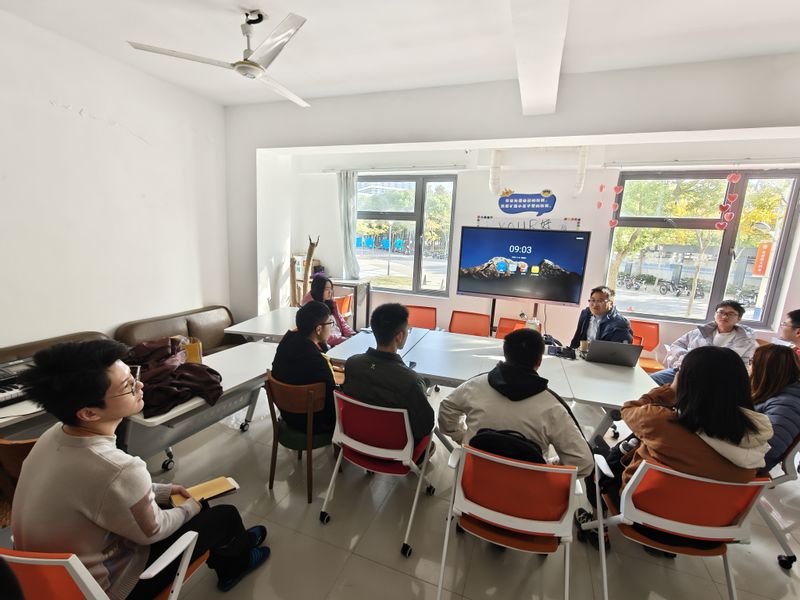
The scene of the on-duty Q&A event
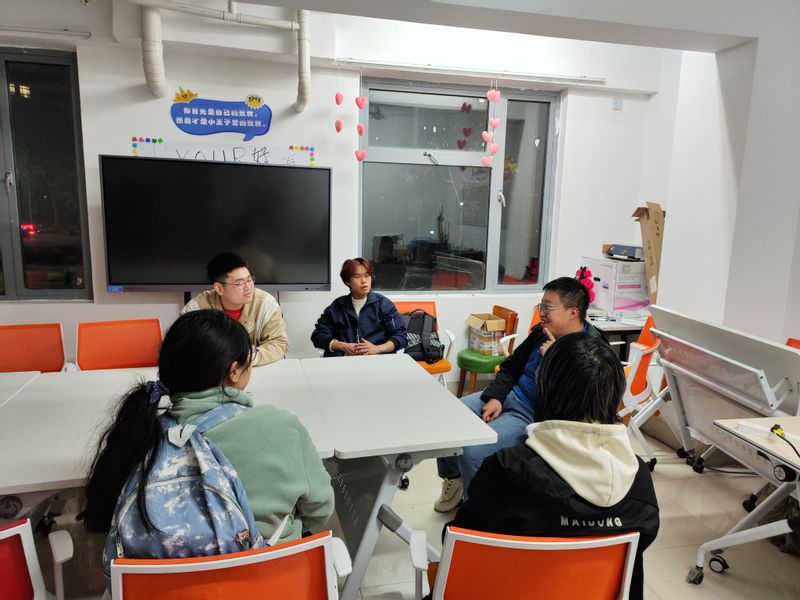
The scene of the self-study tutoring activity